
No, gay marriage is not currently legal in Japan. As of July 29, 2026, two people of the same legal sex cannot register a marriage under Japan’s national Civil Code and Family Register Act.
Same-sex couples may live together, hold a wedding ceremony and obtain partnership certificates in many areas. However, these certificates are not legally equivalent to marriage and do not provide all the rights automatically granted to married couples.
Japan’s Supreme Court is now considering several cases challenging the exclusion of same-sex couples from marriage, but it has not yet issued its final ruling.
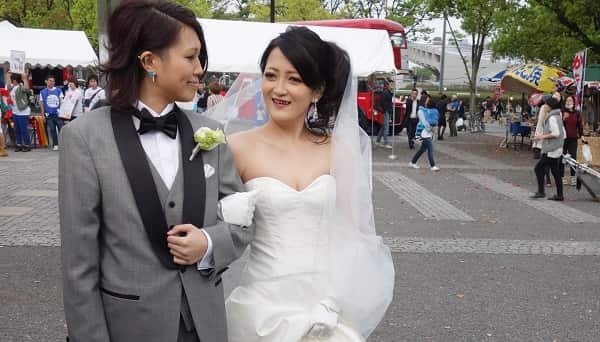
Why Same-Sex Couples Cannot Marry in Japan
A marriage in Japan becomes legally valid when it is registered under the Family Register Act. The Civil Code’s marriage and family provisions continue to operate on the basis of a husband-and-wife relationship. Municipal offices therefore do not normally accept marriage-registration applications from two people recorded as the same sex.
Same-sex relationships themselves are not illegal. Gay and lesbian couples can live together openly, organise private marriage ceremonies and enter contracts concerning property or shared expenses. The legal restriction concerns recognition as married spouses under national law.
Without legal marriage, a same-sex partner does not automatically receive all spousal protections involving inheritance, taxation, family registration, pensions and parental status.
What Are Partnership Certificates?
Many Japanese municipalities and prefectures have introduced partnership systems for same-sex couples. Tokyo began its metropolitan partnership oath system in November 2022.
Under the Tokyo system, two adults can declare that they are life partners. The governor then issues a certificate confirming that the partnership declaration was accepted.
Such a certificate may help couples access certain public housing programmes, hospital visitation arrangements, insurance products, employer benefits and private services. The precise benefits depend on the rules of the local government, hospital, landlord or company.
However, Tokyo’s official guidance clearly states that a partnership oath is different from marriage and does not create the legal consequences of marriage.
A certificate generally does not automatically make one partner the other’s legal heir. It also does not create nationwide spousal tax rights or place both partners in the same family register as a married couple.
Can Same-Sex Couples Protect Their Rights Privately?
Couples can use private legal documents to reduce some of the difficulties caused by the absence of marriage recognition.
For example, a person may prepare a will naming a partner as a beneficiary. Couples may also create agreements covering property, shared expenses and financial responsibilities. Medical powers of attorney or similar documents may help a partner participate in healthcare decisions where permitted.
These arrangements can be useful, but they do not fully reproduce legal marriage. They may require separate documents, professional assistance and cooperation from third parties. Some spousal rights cannot be created through a private contract.
What Have Japanese Courts Decided?
Same-sex couples have filed a series of cases known as the “Freedom to Marry for All” lawsuits. They argue that excluding them from marriage violates constitutional protections involving equality, individual dignity and freedom of marriage.
The lower courts initially produced different conclusions. Some declared the exclusion unconstitutional, while others described the absence of legal protection as being in an unconstitutional condition or within the legislature’s authority.
At the appellate level, five of the six relevant High Court decisions concluded that the current exclusion was unconstitutional. One Tokyo High Court decision reached the opposite conclusion and upheld the existing legal framework.
These judgments created strong political and legal pressure, but they did not automatically legalise same-sex marriage. Courts in these cases considered claims for compensation and constitutional review; they did not directly rewrite the Civil Code or order municipal offices nationwide to begin issuing marriage registrations.
What Is the Supreme Court Considering?
On March 25, 2026, six same-sex marriage cases were referred to the Grand Bench of Japan’s Supreme Court. The Grand Bench consists of all 15 Supreme Court justices and generally handles major constitutional questions.
The Court is expected to decide whether the Civil Code and Family Register Act violate the Constitution by excluding same-sex couples from marriage. As of July 29, 2026, it has not issued its final judgment.
Even if the Supreme Court declares the current system unconstitutional, legislative action may still be needed to amend marriage-registration and family laws. The National Diet would likely need to decide how same-sex marriage, parental rights, inheritance and family registration should operate.
Are Foreign Same-Sex Marriages Recognised?
A same-sex couple legally married in another country should not assume that Japan will treat them as married for every domestic purpose. Japan does not currently provide general national recognition equivalent to that given to opposite-sex marriages.
Some local partnership programmes accept couples who married abroad. Tokyo, for example, allows qualifying couples with an overseas same-sex marriage to apply for its partnership system. That local recognition does not convert the overseas marriage into a Japanese legal marriage.
Therefore, gay marriage remains unavailable under Japan’s national marriage-registration system. Local partnership certificates provide limited practical assistance, while the Supreme Court’s coming constitutional decision may determine whether the National Diet faces a stronger legal obligation to change the law.