
A judicial warrant is issued by a judge or other authorized neutral judicial officer; an ICE administrative warrant is issued within the Department of Homeland Security’s immigration-enforcement system. Both can carry legal consequences, but they are not interchangeable. In particular, ICE paperwork authorizing civil immigration custody should not be mistaken for a judicial search warrant authorizing entry into a private home.
This distinction is especially important because federal immigration forms can prominently display the word “Warrant” even when no judge signed them. ICE commonly uses Form I-200 for an immigration arrest and Form I-205 in connection with removal or deportation. The constitutional rules for entering a dwelling require separate attention, particularly after a disputed ICE policy allowing certain home entries with Form I-205 became public in 2026. Identifying the issuing authority, legal purpose and scope of a document is more reliable than judging it by its title.
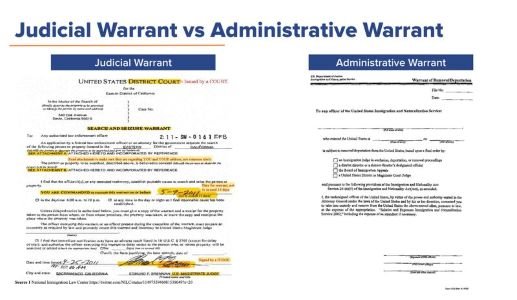
Judicial vs. ICE Administrative Warrants: Comparison
| Feature | Judicial Warrant | ICE Administrative Warrant |
| Issuer | Judge or authorized judicial officer | Authorized immigration official |
| Typical basis | Judicial finding supporting arrest or search | Civil immigration arrest or removal authority |
| Examples | Federal criminal arrest or search warrant | DHS Form I-200 or I-205 |
| Home entry | May authorize entry if legal requirements are satisfied | Home-entry authority under Form I-205 is disputed in 2026 |
| Main limit | Specific person, place, purpose and applicable law | Does not automatically authorize a home search |
What Does a Judicial Warrant Actually Authorize?
A judge-signed arrest warrant directs officers to arrest an identified person. A search warrant identifies a place to be searched and the evidence or property sought. Each is subject to legal limits, and neither gives unrestricted permission to search every room, seize unrelated property or arrest everyone present.
In federal criminal cases, Rule 4 of the Federal Rules of Criminal Procedure governs warrants on complaints, while Rule 41 addresses search warrants. The Fourth Amendment requires a neutral determination of the necessary legal basis. An arrest warrant may support limited entry into the named person’s own home under established constitutional rules; entry into a third party’s residence generally requires additional justification.
What Are ICE Forms I-200 and I-205?
Form I-200 is a Warrant for Arrest of Alien. It is generally issued by an authorized immigration official to direct custody of a person believed to be subject to immigration enforcement. Its legal basis relates to removability or civil immigration custody, not necessarily an allegation that the person committed a criminal offense.
Form I-205 is a Warrant of Removal/Deportation, used in connection with a final removal order. It too is an administrative document, typically signed under immigration authority rather than by an Article III federal judge. A removal order from an immigration judge does not convert an I-205 into a federal judicial search warrant.
How Can the Documents Be Identified?
Review the top of the form, the named issuing authority and the signature block. ICE administrative paperwork usually names the U.S. Department of Homeland Security or ICE and provides a signature for an authorized immigration officer. Judicial warrants identify the issuing court and judge or judicial officer and specify the authorized action.
Do not rely solely on a seal, formal language or the word “warrant.” Court documents can contain errors, and enforcement can be contested even where a document appears valid. When possible, have an attorney examine a copy.
Why Does the Difference Matter for Home Entry?
Ordinarily, a judge-signed warrant with appropriate legal authority, valid consent or an exigent circumstance is required for nonconsensual entry into a private home. Payton v. New York and Steagald v. United States explain the constitutional distinction between arresting a person and entering a residence, especially when it belongs to someone else.
ICE historically instructed officers that Forms I-200 and I-205 alone did not permit entry into private homes. A May 2025 directive, publicized in January 2026, took a different position for some people with final removal orders, asserting that Form I-205 may support entry into their own residences without a separate judicial warrant. DHS has defended the policy; legal challenges dispute its compatibility with the Fourth Amendment. As of October 2026, the policy should not be presented as uncontested constitutional law.
What About Workplaces, Detainers and Other ICE Paperwork?
A public-facing lobby is not the same as a private office or employee-only area. Entry restrictions can differ according to who controls the space and whether consent was given by someone with legal authority. A judicial warrant must still be checked for the particular place and action it covers.
An ICE detainer is different from either type of warrant. It is generally a request directed to another law-enforcement agency concerning custody or notice of release, with separate legal issues governing compliance. A detainer should not be treated as a judge-issued authorization to enter a person’s home.
What Should Happen When Officers Present a Warrant?
Ask to inspect the document without physically interfering, noting the issuer, signature, name, address and type of order. A person may state that entry is not being voluntarily authorized, while remaining calm and following lawful commands. If officers proceed despite an objection, do not physically resist; preserve the details and obtain legal assistance as soon as possible.
A lawyer may examine whether the paperwork matched the location, whether consent was genuinely voluntary and whether any claimed exception applied. Challenges depend on facts and jurisdiction; they cannot safely be resolved by debating legal doctrine at the doorway.
Frequently Asked Questions
Q1. Can a local police officer issue an ICE administrative warrant?
A: Typically, ICE administrative warrants are issued by designated federal immigration authorities, not ordinary local police. Local cooperation arrangements do not by themselves turn a police document into a judge-signed judicial warrant.
Q2. Is an immigration judge the same as a federal district judge?
A: No. Immigration judges conduct administrative immigration proceedings within the executive branch, whereas federal district judges exercise judicial power within the federal court system. Their orders serve different purposes.
Q3. Is a warrant always required before ICE arrests someone in public?
A: No. Federal immigration law permits some warrantless arrests when specific statutory conditions are met, including reason to believe a person is unlawfully present and likely to escape before a warrant can be obtained. The facts of the arrest remain important.
Q4. Does a judicial warrant prove that a person is guilty?
A: No. The warrant authorizes a specified enforcement action; guilt in a criminal case must be determined through the applicable legal process and burden of proof.
Q5. Can the same person be named in both kinds of warrant?
A: Yes. Someone may face separate criminal and civil immigration proceedings, each with its own documents and legal consequences. Resolving one does not necessarily end the other.