
No, it is not illegal to collect rainwater in California. Homeowners, businesses and government agencies may collect rainwater from building rooftops for use on the same property. California law actively recognises rainwater capture as a method of conserving water and reducing stormwater runoff.
However, the legality of a particular system depends on how the water is collected, the size and design of the system, and how the stored water will be used. A small rain barrel used for garden irrigation is treated differently from a large tank connected to indoor plumbing.
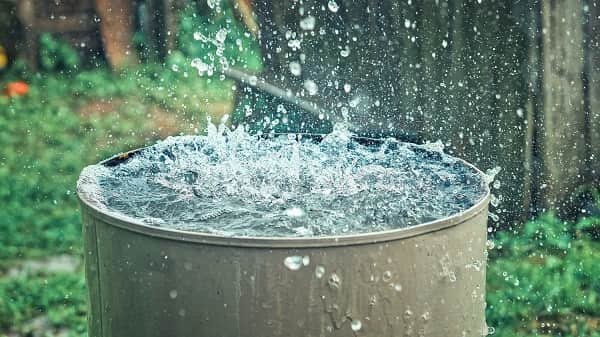
What California Law Says About Rainwater Collection
California adopted the Rainwater Capture Act of 2012 to clarify the legal status of rainwater harvesting. Under California Water Code Section 10574, collecting rainwater from a building rooftop for later use on the same property does not require a state water-right permit.
The law defines a rainwater capture system as a facility designed to collect, retain and store rainwater flowing from a building rooftop for subsequent onsite use. It also recognises a rain barrel as a simple system that does not use electricity or a pump and is not connected to a drinking-water supply.
Therefore, a California homeowner can normally place a barrel beneath a downspout and use the collected water for plants, lawns or other approved non-drinking purposes.
Do You Need a Permit for a Rain Barrel?
A small, gravity-fed rain barrel used outdoors will often not require a building or plumbing permit. However, California does not have one permit rule that applies identically in every city and county.
Local governments may establish requirements based on:
- The tank’s size and height
- Whether it is attached to a building
- Whether a pump or electrical equipment is used
- Whether the system connects to irrigation or indoor plumbing
- Its distance from buildings, slopes and property lines
- How overflow water is discharged
For example, San Luis Obispo County states that a permit is not required for certain outdoor rainwater systems holding up to 360 gallons. Oakland generally does not require a permit for an irrigation system without a pump, but permits may be necessary for pumps, indoor plumbing or tanks of at least 5,000 gallons. These are local examples, not statewide limits.
Property owners should check with their city or county building department before installing a large cistern, underground tank, pressurised system or permanent plumbing connection.
Can Collected Rainwater Be Used Indoors?
Rainwater may potentially be used for approved nonpotable indoor purposes, such as flushing toilets or urinals. However, these systems must comply with the California Plumbing Code and applicable local requirements.
Indoor systems normally require proper pipes, backflow protection, filtration, labels and safeguards preventing rainwater from mixing with the public drinking-water supply. A plumbing permit will usually be required.
California’s water-efficient landscaping rules also state that nonpotable rainwater systems must conform to the California Plumbing Code.
A person should not simply connect a rain barrel to household plumbing without approval. An improper connection could contaminate the drinking-water system and violate plumbing or public-health rules.
Can You Drink Collected Rainwater?
Rainwater should not be assumed to be safe for drinking. Water flowing from a roof may collect dust, animal waste, bacteria, chemicals, roofing particles and other contaminants.
California allows specially designed potable rainwater systems, but they require permits, approved collection surfaces, treatment equipment, testing and compliance with water-quality standards. The system must also be protected from cross-connections with public or private potable-water supplies.
Ordinary rain barrels are generally intended for nonpotable purposes. Containers and outlets should be clearly marked to show that the water is not for drinking.
What Types of Collection May Cause Legal Problems?
The Rainwater Capture Act mainly protects onsite collection before the water enters an offsite storm drain, flood-control channel, stream or other watercourse.
It does not give a person unlimited permission to divert water from a creek, river, public drainage system or neighbouring property. Diverting surface water may involve California water-right laws and could require approval from the State Water Resources Control Board. Unauthorised diversion can result in enforcement action.
A system may also violate local law if its overflow damages a neighbour’s property, causes erosion, creates standing water or directs runoff towards a building. Los Angeles, for example, requires overflow to be directed safely away from buildings, neighbouring properties and unstable slopes.
How to Collect Rainwater Legally and Safely
Use a covered, durable container designed for rainwater storage. Install screens over openings to prevent mosquitoes, insects and debris from entering. The barrel should stand on a stable surface and have an overflow outlet directed towards an approved drainage area.
Rainwater collected from ordinary rooftops can usually be used for landscaping, but caution is needed with roofs containing lead, asbestos, copper, treated wood or other potentially harmful materials.
In conclusion, collecting rooftop rainwater in California is legal and generally encouraged. A simple barrel used for outdoor irrigation is normally straightforward, while larger, pressurised, indoor or drinking-water systems may require local permits and professional installation.