
American organized crime grew into a national force when Prohibition made illicit alcohol enormously profitable. Gang leaders who once controlled street corners became employers of corrupt officials, owners of illegal gambling businesses and brokers of influence in unions and legitimate companies. Over several decades, the Mafia developed a system of bosses, territories and profit-sharing arrangements that allowed criminal enterprises to survive individual arrests. Public fascination with glamorous suits and famous nicknames obscures a history of extortion, coercion and murder.
The personalities behind that history were remarkably different. Al Capone built power through Chicago’s liquor trade; Lucky Luciano helped reorganize New York’s rival gangs into an enduring structure; and John Gotti became a media celebrity while prosecutors assembled evidence of murder and racketeering. Boston’s James “Whitey” Bulger, meanwhile, operated outside the Italian-American Mafia and exposed the dangers of compromised law-enforcement relationships. Not every legendary mob boss was convicted of every crime attributed to him, and historical reputation should not be confused with a court verdict.
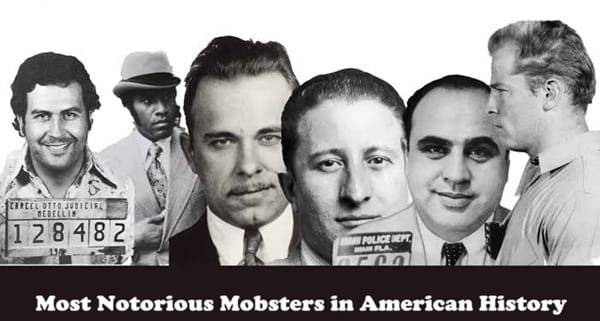
The ten figures below shaped organized crime through leadership, violence, financial influence or the public investigations they provoked. Now let’s check out the top 10 most notorious mobsters in American history.
American Mob History at a Glance
| Mobster | Criminal Sphere | Defining Episode |
| Al Capone | Chicago Outfit | Prohibition empire; tax conviction |
| Lucky Luciano | New York Mafia | Creation of the Commission |
| Carlo Gambino | Gambino crime family | Long, discreet leadership |
| Vito Genovese | Genovese crime family | 1959 narcotics conviction |
| John Gotti | Gambino crime family | Castellano murder; 1992 verdict |
| Whitey Bulger | Boston’s Winter Hill Gang | 11 murders proved at trial |
| Vincent Gigante | Genovese crime family | Secret leadership; racketeering case |
| Frank Costello | Luciano/Genovese family | Political connections and gambling |
| Bugsy Siegel | New York/Las Vegas | Flamingo casino venture |
| Meyer Lansky | National gambling networks | Mob finance and casino investments |
1. Al Capone — The Face of Prohibition-Era Chicago
Capone took control of the Chicago Outfit after Johnny Torrio stepped aside in the 1920s. The organization made fortunes from illegal liquor, gambling and protection rackets, while rival gangs and corrupt officials became part of the city’s criminal economy. The 1929 St. Valentine’s Day Massacre became associated with the era’s gang warfare, though Capone was not convicted of ordering it.
Investigators eventually succeeded through financial records rather than a murder prosecution. In 1931 Capone was convicted of federal tax evasion and sentenced to 11 years. The case showed that seemingly untouchable criminal leaders could be prosecuted through their money.
2. Charles “Lucky” Luciano — Architect of the Modern Mafia
Luciano became influential during New York’s violent struggles for control of organized crime in the early 1930s. After the deaths of rival bosses, he helped establish the Commission, a governing arrangement meant to manage disputes among crime families and allocate lucrative illegal activities.
In 1936 he was convicted in a prostitution-racket case and sentenced to 30 to 50 years. He was released and deported to Italy in 1946. His organizational legacy proved more enduring than his personal command: the Five Families structure continued long after his departure.
3. Carlo Gambino — The Boss Who Favored Secrecy
Gambino led the crime family that bears his name from 1957 until his death in 1976. Unlike flamboyant successors, he cultivated a low public profile while his organization’s associates were active in gambling, loan-sharking, labor racketeering and other illicit markets.
His influence came from alliances, careful management and the ability to avoid prolonged imprisonment despite extensive scrutiny. Public accounts often exaggerate personal involvement in particular murders; the historically supportable point is his central role in making the Gambino family one of New York’s most formidable criminal institutions.
4. Vito Genovese — A Boss Who Removed His Rivals
Genovese rose within Luciano’s organization and sought direct control when Luciano was imprisoned and later deported. In 1957 Frank Costello survived an assassination attempt linked by investigators to a Genovese power struggle, but surrendered leadership. Genovese’s family subsequently carried his name.
A narcotics-conspiracy conviction in 1959 brought Genovese a 15-year federal sentence. He continued exercising influence through associates from prison until his death in 1969. His career demonstrates how leadership contests and succession battles could be as consequential as disputes with outside gangs.
5. John Gotti — The “Teflon Don” Brought Down by Evidence
Gotti became Gambino family boss after Paul Castellano and Thomas Bilotti were murdered outside Manhattan’s Sparks Steak House in December 1985. Federal investigators established that Gotti had arranged the killings. He cultivated celebrity through expensive clothing and courtroom appearances, while the family’s operations involved extortion, gambling and violence.
Previous acquittals gave him the “Teflon Don” nickname. Wiretaps and testimony from associate Salvatore “Sammy the Bull” Gravano changed that. In 1992 a jury convicted Gotti of murder and racketeering. He received life imprisonment and died in custody in 2002.
6. James “Whitey” Bulger — Boston Crime and an FBI Scandal
Bulger led the Winter Hill Gang, an organized-crime network involved in extortion, drugs and violence around Boston. He also supplied information to certain FBI personnel, a relationship that later became notorious because the bureau failed to control conflicts and corruption linked to its informant handling.
Bulger fled before a 1995 indictment and remained a fugitive for years until his capture in California in 2011. A jury convicted him in 2013 of racketeering and crimes involving 11 murders. He was sentenced to two life terms and was killed in prison in 2018.
7. Vincent “The Chin” Gigante — A Boss Behind a Performance
Gigante headed the Genovese family while publicly behaving as if severely mentally ill, sometimes wandering Manhattan in a bathrobe. Prosecutors said the performance helped keep attention away from the criminal decisions he made through intermediaries. Witnesses described hidden leadership over racketeering and violence.
In 1997 he was convicted of racketeering and murder conspiracies; later, he pleaded guilty to obstruction of justice. He died in prison in 2005. His unusual public persona was not the source of his criminal significance: it was the organization he directed behind the scenes.
8. Frank Costello — The Mafia’s Political Fixer
Costello inherited command of Luciano’s New York family and developed a reputation for influence in gambling and political circles. Rather than relying exclusively on street violence, his power depended on relationships, intermediaries and access to profitable businesses.
His 1951 testimony before the televised Kefauver hearings brought organized crime into American living rooms. In 1957 he survived a shooting and yielded control to Genovese. Costello illustrates the political and commercial dimension of mob power, although stories about his reach are sometimes larger than the proven record.
9. Benjamin “Bugsy” Siegel — Mob Money in Las Vegas
Siegel moved between East Coast criminal circles and California rackets before becoming associated with casino development in Nevada. His role in the Flamingo Hotel helped connect organized-crime investment to Las Vegas’s emerging gambling industry. The venture suffered major cost overruns and fierce disputes.
Siegel was killed in Beverly Hills in 1947; the murder remains officially unsolved. Popular accounts often suggest particular conspirators, but no court established who ordered the shooting. His place in mob history comes from the convergence of gambling, investment and organized-crime interests.
10. Meyer Lansky — The Business Side of Organized Crime
Lansky was a close associate of Luciano and Siegel and was linked historically to gambling investments in the United States and Cuba. He developed a reputation as a financial strategist within criminal circles, preferring casinos and business arrangements to public turf wars.
Many stories of a vast personal fortune are poorly documented. Lansky faced investigations but was not convicted of the major racketeering accusations attached to his legend. His enduring importance lies in how organized crime sought to move illicit profits through apparently legitimate businesses.
How the Mafia’s Power Changed
American mobsters profited first from Prohibition and later from gambling, construction, unions, loans and narcotics. Federal racketeering law, surveillance, informants and witness protection eventually made long-running leadership harder to conceal. The history is less a parade of larger-than-life outlaws than an account of institutions struggling to uncover organized, profitable coercion.
Conclusion
These ten men helped shape the methods, mythology and eventual prosecution of American organized crime. Their lives are best understood through the businesses they controlled, the harm they caused and the cases authorities were actually able to prove.