
Switchblades are not completely illegal across the United States. Many states allow adults to own automatic knives, while others restrict their possession, sale, blade length or public carry. Federal law mainly controls importation, mailing and movement through interstate commerce rather than creating a nationwide ban on ordinary possession.
The restrictions that remain are largely the result of concerns that developed during the 1950s about youth violence, concealed weapons and the ability to open these knives quickly with one hand.
What Is Considered a Switchblade?
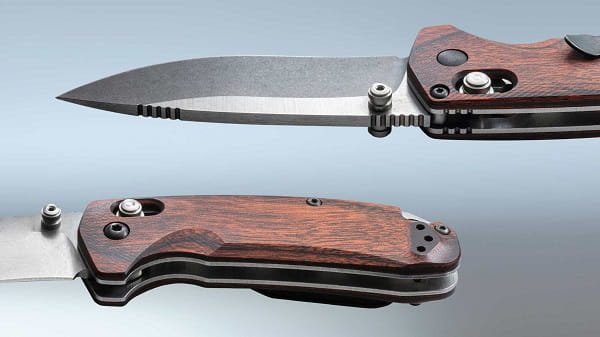
A switchblade, also called an automatic knife, has a folding or sliding blade that opens automatically when the user presses a button, switch or similar mechanism in the handle.
It differs from an ordinary pocketknife, which requires the user to pull the blade open manually. It is also different from many assisted-opening knives. Under federal law, a knife with a mechanism that keeps the blade biased towards the closed position is generally excluded from the switchblade definition when the user must first apply force to the blade.
The exact definition may differ under state law. A knife that is legal under federal rules could still be restricted by a state or city.
Why Were Switchblade Restrictions Introduced?
Switchblades became strongly associated with juvenile gangs and street crime during the 1950s. Newspapers, films and television programmes often portrayed them as the preferred weapons of violent young offenders.
During congressional hearings in 1958, police officials and lawmakers argued that switchblades were frequently carried during robberies and assaults. They believed that restricting interstate sales would make the knives less readily available to teenagers and gang members.
Congress consequently passed the Federal Switchblade Act in August 1958. Several states had already introduced their own restrictions, but the federal law was intended to prevent sellers from avoiding state bans by shipping knives across state lines.
Why Were the Knives Considered Particularly Dangerous?
Lawmakers were concerned about three main characteristics: rapid opening, concealability and ease of use.
A switchblade can usually be opened with one hand in a fraction of a second. Officials feared that someone could carry it secretly and produce an exposed blade before another person had time to react.
The mechanism also gave the knife a threatening reputation. Pressing a button and causing the blade to appear suddenly was seen as more intimidating than manually opening a traditional pocketknife.
However, the automatic mechanism does not necessarily make the blade sharper, longer or more capable of causing injury than every ordinary knife. Modern critics argue that the older laws focused too heavily on how the blade opens rather than how the knife is actually carried or used.
What Does Federal Law Prohibit?
The Federal Switchblade Act generally prohibits knowingly introducing, transporting or distributing switchblades through interstate commerce. It also restricts their manufacture for interstate distribution.
Separate federal rules apply within US territories, Indian country and areas under special federal jurisdiction. Importation is also restricted, and US Customs and Border Protection warns that prohibited automatic knives may be seized when brought into the country.
The federal law contains exceptions. These include certain activities involving the Armed Forces and limited possession and transportation by a person who has only one arm when the blade is three inches or shorter.
Federal law should not be understood as a simple nationwide rule making it a crime for every person to possess a switchblade inside a state.
Why Do State Laws Differ?
Knife regulation is largely controlled by individual states. Some states treat automatic knives in much the same way as ordinary folding knives. Others limit their sale, possession or concealed carry.
A state may allow ownership at home but prohibit carrying the knife in public. Another may permit open carry while restricting concealed carry. Blade-length limits and prohibited locations may also apply.
Schools, courthouses, airports, government buildings and certain public events commonly have broader weapon restrictions. Local ordinances may be stricter than state law, although some states prevent cities from adopting separate knife regulations.
This means a person should check the law for both the state and city involved rather than relying on a general statement found online.
Is Carrying a Switchblade Automatically a Crime?
No. Where automatic knives are legal, carrying one is not automatically criminal. The purpose, location, blade length and manner of carry may still matter.
Using or displaying any knife to threaten another person can lead to serious charges, regardless of whether the opening mechanism is lawful. A legally owned knife can become evidence of assault, robbery or another offence when it is used unlawfully.
Transporting a switchblade between states can also raise issues that would not arise from keeping the same knife entirely within one state.
The Current Legal Position
Switchblade restrictions were created mainly because lawmakers associated automatic knives with youth gangs, hidden weapons and sudden attacks. Those concerns produced the 1958 federal law and numerous state bans.
The legal position has since become less uniform. Several jurisdictions have relaxed older restrictions, while others continue to regulate automatic knives closely.
Therefore, it is inaccurate to say that switchblades are illegal everywhere. Their legality depends on the type of knife, where it is possessed, how it is carried and whether it is imported or transported across state lines.