
Yellowstone National Park’s bison management plan has produced an unusual legal fight because the federal government has been challenged from opposite sides. Montana sued arguing that the 2024 plan gives the park too much flexibility to maintain a larger bison herd and does not adequately protect livestock interests. Conservation groups filed a separate case arguing that the same plan still relies on outdated assumptions about brucellosis and continues aggressive management practices without sufficient scientific justification.
The litigation is more than a dispute over how many bison should live in Yellowstone. It raises federal administrative-law questions under the National Environmental Policy Act, the National Park Service’s governing statutes, the quality of the scientific record, Tribal interests, disease management and the limits of state influence over wildlife inside a national park. As of September 23, 2026, Montana has moved to dismiss its case without prejudice, but the conservation challenge remains active.
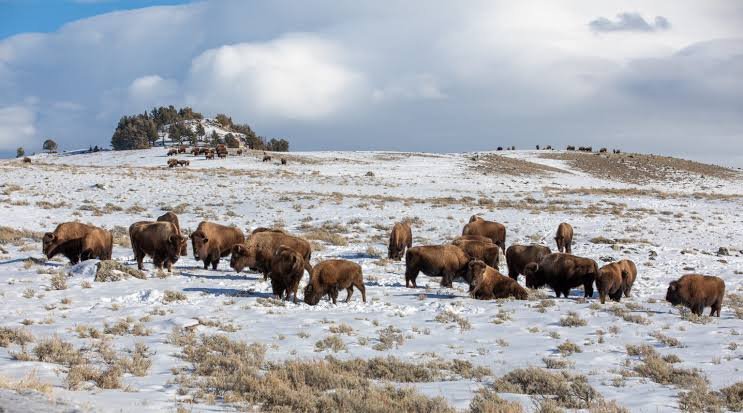
What Does the 2024 Yellowstone Bison Plan Do?
The National Park Service approved the new Bison Management Plan in July 2024 after completing an Environmental Impact Statement under NEPA. It replaced the park’s reliance on a management framework developed in 2000, when concern about brucellosis transmission to cattle played a central role in bison policy.
Under the 2024 decision, Yellowstone generally manages the herd within a range of about 3,500 to 6,000 bison after calving, with an average population of roughly 5,000. The plan uses several tools to manage numbers, including hunting outside the park, transfers of disease-screened animals to Tribal lands, transfers of meat and hides to Tribes and, under specified conditions, additional removals.
The plan also created a population assurance threshold of 5,200. Once the population reaches that level, the Park Service can manage toward a declining population using harvests and, if needed, other removal tools. The agency says the plan reflects newer science, changing livestock conditions around Yellowstone and expanded Tribal participation.
Montana’s Lawsuit Challenged the Plan From the Livestock Side
Montana, acting through the governor and state livestock and wildlife agencies, filed suit on December 31, 2024, in the U.S. District Court for the District of Montana. The state challenged the 2024 Record of Decision and Final Environmental Impact Statement under NEPA, the National Park Service Organic Act and the Yellowstone National Park Protection Act.
Montana argued, among other things, that the federal process did not adequately account for state concerns about bison leaving the park, brucellosis risk and livestock management. The state also objected to changes involving vaccination and the expansion of bison transfers to Tribal governments. It asked the court to set aside the 2024 plan and return the matter to the federal agencies for further work.
Those allegations were contested. The National Park Service’s own decision states that circumstances have changed since 2000, including fewer cattle near the park, modern brucellosis regulations and a larger role for Tribal hunting and conservation transfers.
Conservation Groups Filed a Very Different Challenge
Only weeks later, Alliance for the Wild Rockies and Council on Fish & Wildlife filed their own federal lawsuit. They also attacked the sufficiency of the 2024 environmental review, but their theory was almost the reverse of Montana’s.
The conservation plaintiffs contend that the Park Service continued to treat bison as a central brucellosis threat even though more recent scientific work has identified elk, rather than Yellowstone bison, as the documented source of recent livestock transmissions in the Greater Yellowstone Ecosystem. They also argue that the agency failed to adequately evaluate where migrating bison would actually overlap with cattle and whether continued capture-and-removal practices are scientifically justified.
Their requested remedy is also different. The conservation plaintiffs have sought a revised environmental analysis without automatically vacating the 2024 plan. That distinction matters because vacatur could revive an older management framework while the agency performs new analysis.
Why the Two Cases Were Consolidated
In September 2025, U.S. District Judge Brian Morris consolidated the Montana and conservation cases for scheduling purposes. The court noted that both challenged the legal sufficiency of the same 2024 bison plan and NEPA analysis, even though they sought different results.
The cases did not become a single lawsuit in every respect. Each retained its own parties and legal positions. Consolidation mainly reduced the risk of conflicting schedules or rulings concerning the same administrative record.
Tribal Interests Add Another Important Legal Dimension
The litigation also affects the Bison Conservation Transfer Program, which allows Yellowstone bison that complete disease-screening requirements to be transferred to Tribal lands. The Fort Peck Assiniboine and Sioux Tribes and several conservation organizations moved to participate in defense of the plan.
For Tribal Nations, the controversy is not limited to herd size. Bison restoration can involve cultural, nutritional, ecological and sovereignty interests. This means a court considering a remedy must be aware that striking down the plan could affect programs relied on by parties that were not responsible for the original dispute between Montana and the federal government.
The National Park Service Is Reopening Its Environmental Analysis
A major development came on April 29, 2026, when the National Park Service announced that it would prepare a Supplemental Environmental Impact Statement. The agency said seasonal bison migration outside Yellowstone had become less predictable in timing and duration, affecting assumptions used in the 2024 analysis.
The agency also expressly acknowledged the two federal lawsuits and said it would determine whether issues raised in those cases should receive additional analysis. The supplemental process may consider new alternatives as well as options that were previously dismissed from detailed study.
The Court Refused to Put the Litigation on Hold
After announcing the supplemental review, federal defendants asked the court to stay the litigation while the agency worked on the new analysis. Judge Morris denied that request in July 2026. The case therefore continued instead of being placed on an indefinite pause.
That ruling did not decide whether the 2024 plan is lawful. It dealt with case management and whether the pending agency process justified delaying judicial review. The underlying NEPA and administrative-law claims remained unresolved.
Montana Has Now Asked to Dismiss Its Case
On September 14, 2026, Montana and the federal government jointly asked the court to dismiss Montana’s challenge without prejudice. Their filing pointed to the Supplemental Environmental Impact Statement and the possibility that the new process could address or resolve the state’s concerns.
A dismissal without prejudice is important because it generally does not operate as a final decision on the merits and does not necessarily prevent a future challenge to a later agency action. Montana’s request also does not end the separate lawsuit brought by Alliance for the Wild Rockies and Council on Fish & Wildlife.
As of September 23, 2026, the conservation case remains the live challenge to the 2024 plan and is expected to continue while the Park Service works on its supplemental environmental review.
What Are the Main Legal Questions?
The Yellowstone litigation is likely to turn less on whether one side has the better wildlife policy and more on whether the federal agency followed administrative-law requirements. The central questions include:
- Whether the Environmental Impact Statement took the required hard look at current scientific evidence and foreseeable environmental effects.
- Whether the Park Service reasonably explained its treatment of brucellosis risk, bison migration and livestock exposure.
- Whether the agency considered a legally adequate range of management alternatives.
- Whether consultation and coordination with Montana satisfied applicable federal obligations.
- Whether the administrative record supports continued capture, removal and disease-management practices.
- What remedy would be appropriate if the court finds the environmental analysis legally deficient.
Why the Supplemental EIS Could Change the Lawsuits
The supplemental review creates several possible outcomes. The Park Service could retain much of the 2024 approach but provide stronger analysis, adopt a materially different alternative, or change particular tools used to manage bison migration and disease risk.
A new final agency decision could resolve some claims, make others moot or create a new basis for judicial review. Until that process is completed, however, the existing litigation remains important because it tests whether the 2024 decision was lawful when it was made.
Conclusion
The Yellowstone bison plan lawsuits are a genuine and unusually complex environmental-law dispute. Montana challenged the 2024 plan as insufficiently protective of livestock and state interests, while conservation groups attacked it for continuing restrictive bison management on what they describe as outdated disease assumptions. The two cases therefore reached the same federal plan from opposite directions.
Montana’s September 2026 request for dismissal narrows the courtroom fight but does not end it. The remaining conservation lawsuit and the Park Service’s new Supplemental Environmental Impact Statement will determine whether the 2024 framework survives, is rewritten or becomes the starting point for another round of federal review.