
Some criminal cases become international stories because the acts themselves are extraordinary. Others disturb the public because the offender appeared to be a trustworthy caregiver, a respectable businesswoman or an ordinary member of a community. In crimes committed by women, these contrasts have often dominated the headlines, sometimes at the expense of the victims and the evidence. The more revealing questions are what happened, how investigators uncovered it, what a court established and whether the popular story has grown beyond the facts.
The cases in this article span different centuries and countries, from nineteenth-century Britain’s exploitation of vulnerable infants to drug trafficking in the United States, serial killings in Mexico, and an elaborate New York fraud. Some offenders abused personal relationships; others exploited social isolation, financial desperation or professional trust. Their legal outcomes also differ sharply. A suspected murder count, a charge, a guilty plea and a criminal conviction cannot be treated as the same thing.
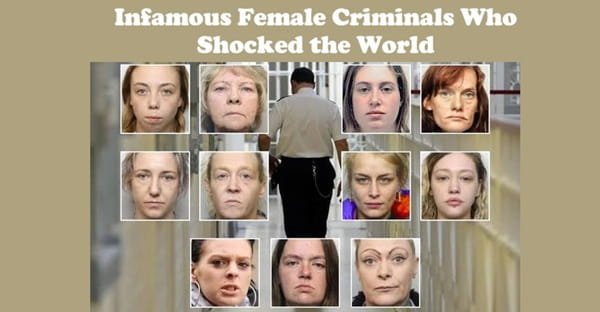
The following ten cases are remembered for their impact, the investigative breakthroughs that exposed them and the questions they raised about justice. Now let’s check out the top 10 infamous female criminals who shocked the world.
Ten Cases at a Glance
| Individual | Country | Crime and Legal Outcome |
| Aileen Wuornos | United States | Six murder convictions; executed |
| Griselda Blanco | Colombia / US | Cocaine trafficking; murder guilty pleas |
| Rose West | United Kingdom | Convicted of ten murders |
| Myra Hindley | United Kingdom | Moors murders; life imprisonment |
| Dorothea Puente | United States | Convicted of three tenant murders |
| Karla Homolka | Canada | Manslaughter plea; 12 years |
| Juana Barraza | Mexico | Convicted of 16 murders |
| Amelia Dyer | United Kingdom | Infant murder conviction; executed |
| Nannie Doss | United States | Pleaded guilty to killing husband |
| Anna Sorokin | United States | Grand larceny and theft convictions |
1. Aileen Wuornos — Murders Along Florida Highways
Wuornos, a woman working as a sex worker, killed several men in Florida in 1989 and 1990. Police traced linked shootings and recovered evidence associated with stolen vehicles and belongings. She claimed self-defense against sexual assaults, a defense disputed by prosecutors and rejected in her criminal trials.
Wuornos was convicted of six murders and sentenced to death. She was executed in 2002. Her case prompted debate about trauma, mental health and exploitation, but those questions do not change the court’s findings or the lives lost.
2. Griselda Blanco — The Cocaine Trade’s Violent Powerbroker
Colombian trafficker Griselda Blanco helped expand cocaine distribution networks reaching Miami during the 1970s and 1980s. Investigators associated her organization with drug profits, hired violence and fierce competition over the American market. Her name became closely tied to the bloody Miami cocaine wars.
Blanco was convicted on federal drug charges and later pleaded guilty to three second-degree murder counts in Florida. Much larger murder totals often attributed to her remain unproven. Released and deported to Colombia in 2004, she was shot dead in Medellín in 2012.
3. Rose West — Killings Behind a Family Home
Rosemary West and her husband Fred became the focus of a major British police investigation after human remains were discovered in and around properties associated with the couple. Witness testimony and forensic discoveries exposed crimes against girls and young women, including members of their family.
Fred died by suicide before trial. Rose was convicted of ten murders in 1995 and received life sentences. The case was especially disturbing because a home presented as ordinary family space concealed prolonged violence and serious failures to protect vulnerable victims.
4. Myra Hindley — The Moors Murders
Hindley and Ian Brady abducted and killed children and teenagers in England during the 1960s. Police investigations uncovered evidence linking the pair to victims buried on Saddleworth Moor. The crimes produced lasting national grief, and families spent years seeking answers about missing children.
In 1966 Hindley was convicted of two murders and of being an accessory after another murder; Brady was convicted of three murders at that trial. Both received life sentences. The pair later acknowledged involvement in additional killings. Hindley died in prison in 2002.
5. Dorothea Puente — Tenants Betrayed for Their Benefits
Puente ran a Sacramento boardinghouse catering to older and vulnerable residents. When a tenant disappeared, investigators began digging around the property and ultimately discovered seven bodies in the yard. Prosecutors alleged Puente killed residents while continuing to collect their government benefits.
She was charged in nine deaths, but the jury convicted her of three murders in 1993 and failed to reach verdicts on the other six. Puente received life without parole and died in prison in 2011. The distinction between the charged and convicted deaths is essential to telling this case accurately.
6. Karla Homolka — The Plea Deal That Divided Canada
Homolka and her then-husband Paul Bernardo were responsible for crimes involving teenage victims in Ontario in the early 1990s. After the investigation, Homolka reached a plea agreement requiring cooperation with prosecutors and testimony against Bernardo.
She pleaded guilty to manslaughter and received a 12-year sentence. Videotape evidence later raised serious questions about how fully her involvement had been represented during negotiations. She completed the sentence and was released in 2005. The case remains a prominent example of controversy over plea bargains and disclosure of evidence.
7. Juana Barraza — A Murder Investigation in Mexico City
Barraza, a former wrestler, became known as “La Mataviejitas,” or the Little Old Lady Killer. Investigators linked a succession of killings of older women in Mexico City, some involving an offender who gained entrance to homes by appearing trustworthy or offering assistance.
She was arrested in 2006 and convicted in 2008 of murdering 16 elderly women and committing robberies. The court imposed a cumulative sentence of 759 years, although local rules limited the period she could actually serve. The case exposed the vulnerability of isolated older people.
8. Amelia Dyer — A Dark Chapter in Victorian Childcare
In nineteenth-century England, Dyer took payments to care for infants whose families could not raise them. Police eventually connected her to an infant whose body was found in the Thames, revealing a disturbing pattern in the largely unregulated practice known as “baby farming.”
She was tried and convicted of a child’s murder and executed in 1896. Claims that she killed hundreds of infants are widely repeated but cannot be established with precision. The case helped intensify public demands for oversight of paid childcare and adoption arrangements.
9. Nannie Doss — Poisoning in the Family
Doss came under suspicion after the death of her husband Samuel in Oklahoma in 1954. Investigators found arsenic poisoning, and she admitted involvement in several family deaths. Newspapers called her the “Giggling Granny,” a nickname that obscured the seriousness of the offenses and the victims.
In 1955 Doss pleaded guilty to murdering Samuel Doss and received life imprisonment. She was not separately tried for every death mentioned in her confession. She died in prison in 1965. Her case shows why investigators must examine patterns rather than assume repeated family deaths are unrelated.
10. Anna Sorokin — The Fake Heiress Who Deceived Manhattan
Using the name Anna Delvey, Sorokin presented herself to New York socialites, hotels and financial institutions as an heiress with access to a large overseas fortune. She obtained services and financial advantages through that persona while pursuing plans for an exclusive arts club.
In 2019 a New York jury convicted her of grand larceny, attempted grand larceny and theft of services, while acquitting her on other charges. Unlike the violent cases above, this one turned on fabricated wealth and social credibility. It exposed how reputations can substitute for proper verification.
What These Cases Have in Common
The victims were often people with limited protection: children, tenants dependent on housing, isolated older adults or individuals who trusted a compelling personal story. The investigations depended on different forms of proof, from forensic evidence and financial records to witness testimony. The strongest account of any case separates what police suspected from what courts established.
Conclusion
These crimes shocked communities in different ways, but none should be remembered merely as a sensational nickname. Their history is best told through the victims, the evidence that exposed wrongdoing and the justice systems that responded.