
Yes, natural kratom leaf remains legal in Ohio in 2026, but many concentrated kratom compounds and extracts are now controlled substances. This distinction became particularly important after Ohio adopted a new rule concerning mitragynine-related compounds.
Effective May 19, 2026, Ohio classifies a broad group of mitragynine-related compounds as Schedule I controlled substances. However, the rule expressly excludes mitragynine in vegetation form, including natural kratom leaf and ground natural kratom leaf.
As a result, someone buying traditional kratom powder should not assume that the same rules apply to concentrated extracts, enhanced 7-OH tablets, shots or similar products.
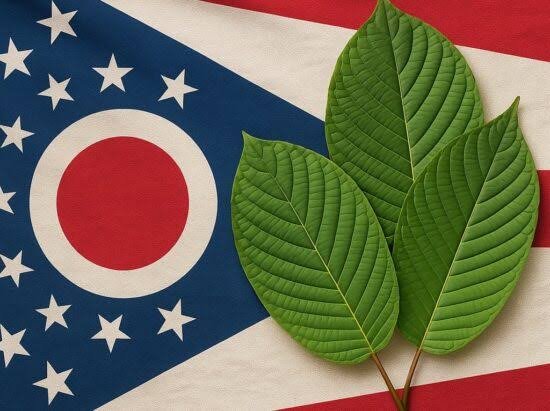
What Kratom Is Legal in Ohio?
Ohio’s current rule makes an important distinction between traditional botanical kratom and concentrated kratom-related compounds.
Natural forms that are expressly excluded from the new Schedule I classification include:
- Natural kratom leaf
- Ground natural kratom leaf
- Mitragynine in vegetation form
Kratom comes from Mitragyna speciosa, a plant native to Southeast Asia. Mitragynine is one of its main naturally occurring alkaloids.
Ohio’s exemption means traditional leaf material has not been placed into Schedule I simply because it naturally contains mitragynine.
Are Kratom Extracts Legal in Ohio?
Consumers need to be much more careful with extracts.
Ohio’s 2026 rule broadly schedules mitragynine-related compounds found in resinous extracts of kratom unless a specific exception applies. The natural-leaf exception is limited to mitragynine in vegetation form, including natural and ground leaf.
This means products marketed as:
- Kratom extracts
- Enhanced kratom
- Concentrated alkaloid products
- Kratom shots
- High-potency tablets
- Concentrated 7-OH products
should not automatically be treated as legal simply because the package uses the word “kratom.”
The chemical composition and form of the product now matter significantly under Ohio law.
Is 7-OH Legal in Ohio?
No. 7-hydroxymitragynine, commonly called 7-OH, is specifically listed as a Schedule I controlled substance under Ohio’s current rule.
Other expressly listed compounds include:
- Mitragynine pseudoindoxyl
- Dihydro-7-hydroxy mitragynine
- 7-acetoxymitragynine
The rule applies to synthetic and naturally occurring mitragynine-related compounds subject to its stated exceptions.
This makes the distinction between ordinary botanical kratom and concentrated 7-OH especially important.
Some products sold as kratom tablets, gummies or shots may contain substantially enhanced levels of 7-OH rather than simply consisting of ground kratom leaf.
Can You Possess Natural Kratom in Ohio?
Ohio’s Schedule I rule expressly excludes natural kratom leaf and ground natural kratom leaf from its classification of mitragynine-related controlled substances.
Therefore, possession of ordinary natural kratom leaf is not prohibited under this particular controlled-substance rule.
Possessing a product containing a Schedule I kratom-related compound is a different matter. Ohio Revised Code Section 2925.11 generally prohibits knowingly obtaining, possessing or using a controlled substance except under recognized legal exceptions.
The potential criminal consequences depend on the particular controlled substance, amount and circumstances involved.
Can You Buy Kratom in Ohio?
Traditional natural kratom leaf and ground leaf can remain available because they fall within Ohio’s botanical exception.
However, shoppers should check exactly what they are purchasing.
A product labeled simply “kratom” could contain:
- Ground botanical leaf
- Concentrated mitragynine
- Added or enhanced 7-OH
- Other kratom-derived alkaloids
- Synthetic kratom-related compounds
Those products are not necessarily treated the same way under Ohio law.
The safest legal distinction in 2026 is between plain natural leaf material and concentrated or chemically enhanced products.
Why Did Ohio Change Its Kratom Rules?
Ohio’s State Board of Pharmacy adopted its current rule amid growing concern about concentrated 7-OH and other potent kratom-related compounds.
The issue has also attracted federal attention. In July 2026, the U.S. Drug Enforcement Administration announced the start of a temporary scheduling process targeting 7-OH above a specified threshold and several related substances.
Importantly, the DEA stated that its action was intended to target concentrated and synthetic products rather than botanical kratom containing only naturally occurring trace levels of 7-OH.
The FDA has likewise distinguished concentrated 7-OH products from traditional kratom leaf while warning consumers about the risks associated with 7-OH products.
Is Kratom FDA Approved?
No. Kratom should not be confused with an FDA-approved medication.
The FDA states that it has not approved prescription or over-the-counter drug products containing kratom, mitragynine or 7-OH for medical use. The agency has also taken enforcement action against products marketed with unapproved therapeutic claims and concentrated 7-OH products.
Therefore, the fact that natural kratom leaf may be lawful to possess under Ohio’s controlled-substance rules does not mean the FDA has approved it as a medicine or dietary supplement.
Are Ohio’s Kratom Laws Likely to Change Again?
Further regulation remains possible.
Ohio lawmakers are considering legislation specifically addressing the sale of kratom products. Senate Bill 299 and House Bill 587 were introduced during the 136th General Assembly to establish rules concerning kratom sales.
As of August 22, 2026, neither bill has completed the legislative process or become law. Senate Bill 299 remains in Senate committee, while House Bill 587 has received hearings in the House Agriculture Committee but has not passed the House.
Consumers should therefore distinguish between rules that are already effective and proposals that may change Ohio’s kratom market in the future.
Final Word
Kratom is only partly legal in Ohio in 2026. Natural kratom leaf and ground natural kratom leaf remain expressly excluded from Ohio’s Schedule I classification, so traditional botanical kratom has not been completely banned.
The situation is very different for concentrated products. Ohio now classifies 7-hydroxymitragynine and a broad range of other mitragynine-related compounds as Schedule I controlled substances, with the rule taking effect on May 19, 2026.
For anyone buying kratom in Ohio, simply seeing “kratom” on a package is no longer enough. The safest approach is to know whether the product is plain botanical leaf or contains concentrated, enhanced or synthetic kratom-related compounds.