
The legal rule changes sharply with the place being searched. A patrol officer looking inside a car, an officer checking a person for weapons, and a detective entering a private bedroom do not all have the same powers. Under the Fourth Amendment, a warrant is often the starting requirement for a government search, especially in a home. But courts recognize carefully defined exceptions for consent, urgent circumstances, automobiles, arrests, and certain safety or administrative needs. Each exception has its own factual test and limits. A lawful traffic stop, for example, does not automatically authorize a search of every bag in the vehicle. Understanding the category of search is essential to deciding whether an officer needed prior judicial approval.
Warrant Exceptions: Quick Comparison
| Search situation | Possible legal basis | Main boundary |
| Home or apartment | Consent or genuine exigent circumstances | Strong presumption against warrantless entry |
| Car on a public road | Probable cause under automobile exception | Search limited to places where suspected evidence could fit |
| Person during an investigative stop | Reasonable suspicion of being armed and dangerous | Limited protective pat-down, not general evidence search |
| Person after lawful custodial arrest | Search incident to arrest | Digital phone contents generally require a separate warrant |
| Property in lawful police custody | Valid standardized inventory procedure | Cannot be a pretext for unrestricted investigation |
Consent Searches: Permission Must Be Valid
Police may ask an individual to permit a search of a vehicle, bag, or residence. If consent is voluntary and given by someone with proper authority, a warrant may not be required. Consent is measured by what a reasonable person would understand was authorized; agreeing to inspect a bag does not necessarily permit dismantling a vehicle or searching an unrelated private room.
A person may usually decline a voluntary request and may withdraw consent for further searching. However, another independent ground, such as probable cause plus the automobile exception, may allow officers to continue. Whether another occupant can consent to a shared space depends on common authority and, in some situations, an expressly objecting resident.
Searches During an Emergency
Immediate danger can justify action before a judge is available. Police may enter to provide emergency assistance, stop ongoing violence, pursue a fleeing suspect in legally sufficient circumstances, or prevent genuinely imminent destruction of evidence. Officers need objective facts supporting the asserted urgency; a general concern that evidence might disappear eventually is not enough.
In Case v. Montana (January 2026), the Supreme Court reaffirmed that emergency aid permits limited home entry when officers reasonably believe someone needs immediate help, without demanding the ordinary criminal-investigation probable-cause standard. Such authority ends at the emergency’s reasonable boundaries. The separate case Lange v. California (2021) makes clear that pursuit of a misdemeanor suspect does not automatically authorize entry into a home.
When Can Police Search a Vehicle?
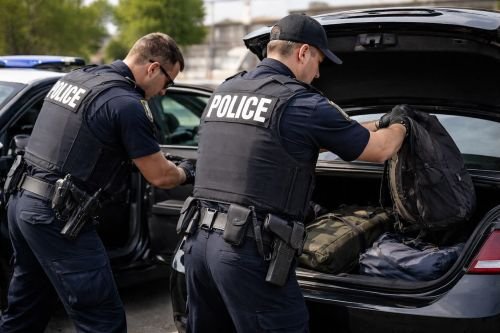
Under the automobile exception, officers with probable cause to believe a readily mobile vehicle contains evidence or contraband may generally search it without first securing a warrant. The permitted areas and containers depend on what officers reasonably expect to find. Probable cause to locate a large stolen object, for instance, does not necessarily justify opening a tiny container unable to hold it.
A traffic violation by itself normally authorizes the stop, not a general evidence search. Officers may have separate grounds to conduct a protective weapons check or an inventory after a lawful impoundment, but each requires its own conditions. The automobile exception also does not grant permission to enter the protected area around a home merely to reach a vehicle; Collins v. Virginia (2018) addressed that distinction.
Stops, Arrests, and Protective Searches
Terry v. Ohio (1968) permits a limited frisk for weapons when an officer reasonably suspects a detained person is armed and dangerous. The frisk is a safety measure, not permission to empty every pocket to search for drugs. A lawful custodial arrest supports a search of the arrested person’s body and, depending on circumstances, the area within immediate reach under Chimel v. California (1969).
The rule does not convert a lawful arrest into blanket access to a house or phone. In Riley v. California (2014), the Supreme Court held that police generally need a warrant to search the digital contents of a cellphone seized from an arrestee. Searches of vehicles after a recent occupant’s arrest also have limits under Arizona v. Gant (2009).
Plain View, Inventories, and Other Narrow Categories
Officers may seize immediately apparent evidence in plain view if they are lawfully positioned and have lawful access to the item. They cannot manufacture plain view by illegally opening a closet. Inventory searches of lawfully impounded vehicles or booked belongings may be valid when conducted under standardized procedures for legitimate caretaking purposes, rather than as a disguised evidence hunt.
Some border searches and certain probation or parole supervision searches follow specialized rules. Their legality depends on location, search intrusiveness, the governing statutes, and the person’s legal status. These doctrines should not be applied casually to an ordinary home or street encounter.
What Determines Whether the Search Was Lawful?
- The place and item searched, including whether the location was a home, vehicle, person, or personal device.
- Facts known to the officer before the search, not just evidence discovered afterward.
- Whether consent was voluntary and within the consenting person’s authority.
- Whether the search remained within the purpose and physical scope of the applicable exception.
- Any more protective state constitutional rule, statute, or agency restriction.
A defense attorney can seek suppression when evidence was obtained through an unconstitutional search. Courts review the exact sequence of events, and the remedy depends on the violation and applicable exceptions to suppression.
Frequently Asked Questions
Q1. Can police search a passenger’s backpack during a traffic stop?
A: Not simply because the car was stopped. Valid consent, probable cause permitting a vehicle search of containers capable of holding the suspected evidence, or another specific exception may support it. Ownership and the officer’s factual basis matter.
Q2. Does the smell of marijuana always justify a vehicle search?
A: No universal answer applies. Marijuana legalization, hemp laws, state court rulings, and the circumstances of the stop differ significantly. An odor alone may have different legal consequences in different states and should not be treated as an automatic nationwide rule.
Q3. Can police inspect household trash set out for public collection?
A: Sometimes. California v. Greenwood (1988) held that a warrant is generally not needed to search garbage left for collection in an area accessible to the public. Trash retained in a protected area of the home can present a different question under the Fourth Amendment or stricter state law.
Q4. Are airport security screenings the same as ordinary police searches?
A: No. Routine airport screening operates under specialized administrative-search principles focused on transportation safety. The presence of law enforcement or discovery of potential criminal evidence can raise additional legal issues depending on the screening and any later investigative search.
Q5. Can a search be valid under federal law but invalid under state law?
A: Yes. State constitutions and statutes can provide stronger protections than the federal Fourth Amendment minimum. The admissibility of evidence and availability of remedies may also depend on whether the prosecution is in state or federal court.
Legal disclaimer: General U.S. search-and-seizure information only, not advice about a specific encounter. Federal, state, and local rules differ. A qualified attorney can assess individual facts and available remedies.